How Big Can Raindrops Get on the Moon, and Mars?
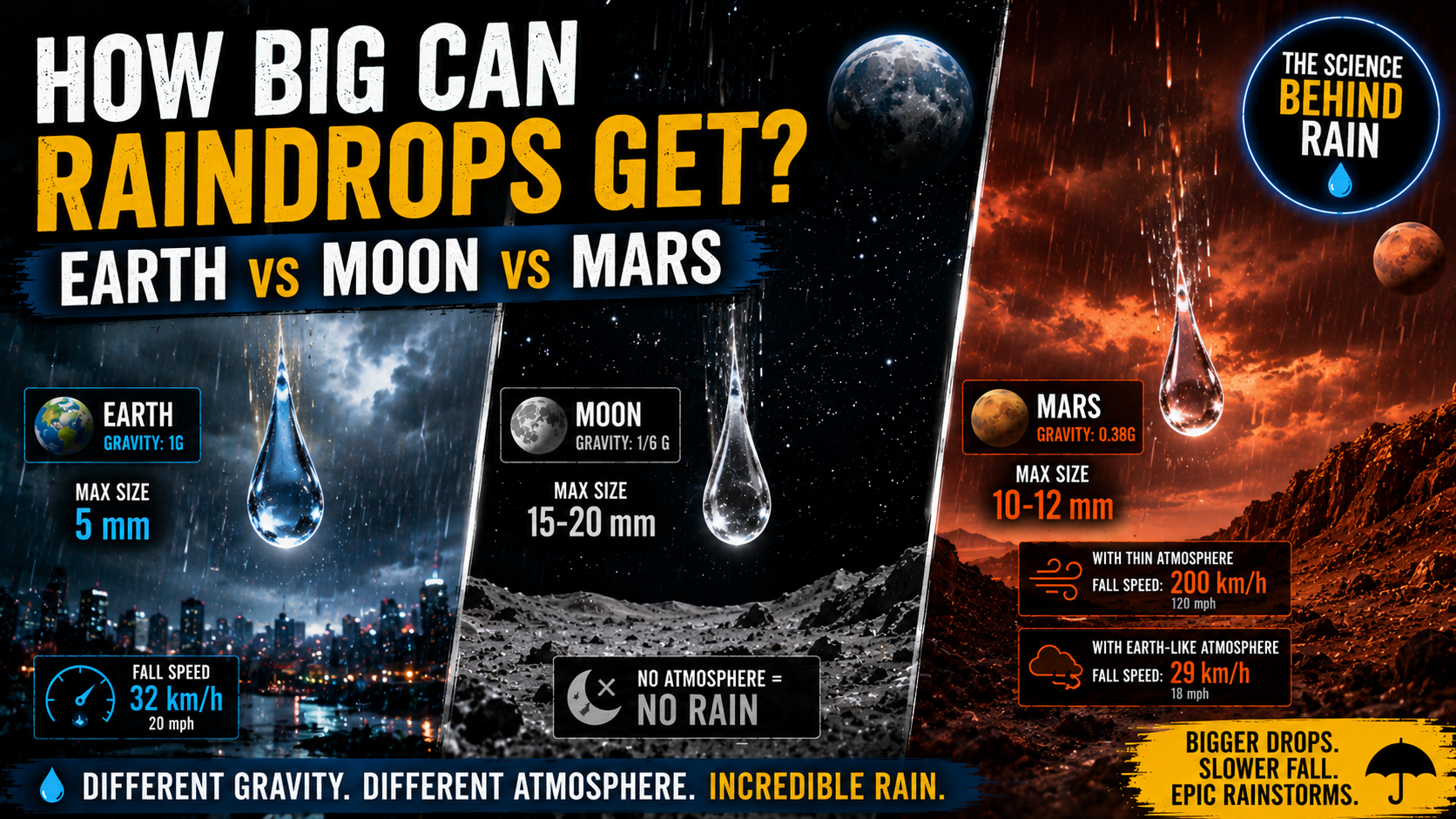
Rain might seem simple at first glance, but the science behind raindrops is actually pretty fascinating. On Earth, raindrops can only grow to about 5 millimeters wide before gravity and air resistance cause them to become unstable and break apart into smaller drops. Most large raindrops fall at speeds of around 32 km/h (20 mph) as they move through the atmosphere.
The reason raindrops break apart has a lot to do with air pressure and drag. As a raindrop grows larger, air pushing against it from below causes the drop to flatten into more of a hamburger bun shape rather than the classic teardrop shape people often imagine. Once the drop becomes too large, it destabilizes and splits into smaller droplets.
But what if rain existed on other worlds? Things could get really interesting.
Rain on the Moon
The Moon has only about 1/6 of Earth’s gravity, meaning falling water would behave very differently there. In theory, raindrops on the Moon could grow much larger before breaking apart, possibly reaching sizes of 15-20 millimeters wide.
There’s just one small problem: the Moon doesn’t currently have a real atmosphere, so rainstorms aren’t exactly in the forecast anytime soon. Without atmospheric pressure, liquid water can’t behave the way it does on Earth. Still, it’s fascinating to imagine what giant slow-falling lunar raindrops might look like in a future human colony with artificial atmospheric conditions.
Rain on Mars
Mars is where things get even more interesting. The Red Planet has about 38% of Earth’s gravity, so raindrops there could theoretically grow to around 10–12 millimeters wide before breaking apart. That’s roughly twice the size of many large Earth raindrops.
But Mars also has a much thinner atmosphere than Earth, and that dramatically changes how rain would fall. In Mars’ current atmosphere, those large raindrops could potentially fall at speeds approaching 200 km/h (120 mph) because there isn’t enough air resistance to slow them down effectively. You’d need a lot more than an umbrella to survive a Martian rainstorm.
However, if Mars had an Earth-like atmosphere, the story changes completely. Lower gravity combined with thicker atmospheric pressure would create rainstorms that looked much slower and more graceful than rain on Earth. A large 12 mm Martian raindrop would hit the ground at only about 29 km/h (18 mph) compared to nearly 50 km/h (31 mph) for similar large drops on Earth.
Instead of millions of tiny fast impacts like normal Earth rain, standing in a Martian rainstorm might feel more like:
large slow-moving water blobs
heavier splats
fewer drops overall
but much wetter impacts
Almost like standing under a giant slow-motion water balloon sprinkler.
IS that cool or what?
Personally I don’t think Humans will ever live on Mars for various reasons but it’s cool to imagine what life there might look like. I wonder what giant raindrops would sound like on a stormy night? Relaxing or terrifying? Let me know what you think in the comments.